
Reporting crime or safety concerns
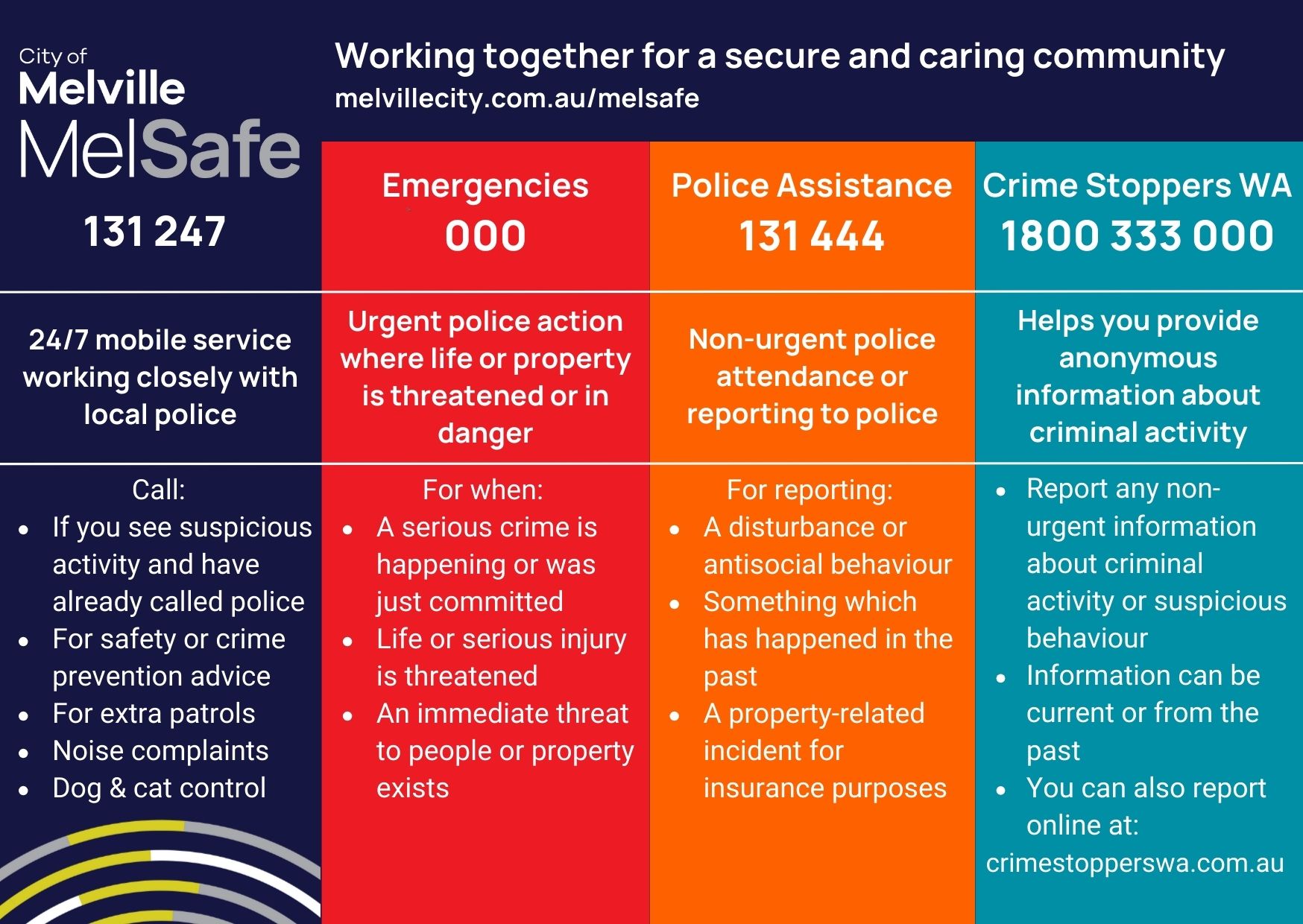
Download our summary of important contact numbers or pick up a handy fridge magnet version from one of our libraries, leisure centres, community centres, or the Civic Centre.- Emergency – 000 for life threatening situations
- Police assistance – 131 444 when police attendance is required
- MelSafe – 131 247 for MelSafe attendance to observe and report suspicious behaviour to the police
- Crime Stoppers WA – 1800 333 000 or www.crimestopperswa.com.au to anonymously report suspicious behaviour and crime online or over the phone
Visit the WA Police Force website for more information on when to call 000 and 131 444. You can also:
Specific issues and how to report
Antisocial behaviour disturbs, annoys or interferes with someone’s ability to go about their lawful business. The following are NOT antisocial behaviours:
- Children playing
- Young people walking, riding or sitting together in groups
- Religious or cultural practice or dress
- Smoking legal substances in designated areas
- Parties or celebrations
- Using public spaces at night
- Homelessness.
If you are unsure if a behaviour is antisocial or would like some advice on where to report it to, contact MelSafe 24/7 on 131 247 and someone will be able to advise you.
Report the following common types of cybercrime and scams to the Australian Cyber Security Centre:
- Phishing scams
- Relationship scams
- Investment scams
- Account or identity takeover scams
- Buying and selling scams
- Threat scams
- Jobs and employment scams
- Unexpected money scams
- Business email compromise scams
- Money recovery scams
- Donation scams
Not affected by a scam but want to report it? Report a scam to the National Anti-Scam Centre - Scamwatch.
Report the following types of online abuse to the Australian Government Office of eSafetyCommisioner:
- Image based abuse
- Cyberbulling (for someone under 18)
- Adult cyber abuse
- Illegal and harmful content
Visit the WA Police Force website for more information.
Contact Crime Stoppers WA on 1800 333 000 or report online if you have information on:
- Alleged illegal drug dealers
- The alleged manufacture of illegal drugs or
- The use of illegal drugs
Reports made to Crime Stoppers WA can be done anonymously.
Visit our graffiti webpage for more information.
We have processes in place to respond to concerns regarding homelessness. Visit our homelessness page to find out more including FAQ’s and support services.
You can report hoon behaviour on the WA Police Force website. Do not put yourself at risk when trying to gather evidence. If immediate police attendance is required, call 131 444 to report the incident.
Call MelSafe on 131 247 to report noisy parties or ongoing noise disturbances. Additionally, the City's Environmental Health Officers provide services to residents and help to ensure compliance with the Environmental Protection Act relating to noise pollution. Visit our noise page for more information.
If you find sharps (which includes needles, syringes and lancets) discarded in parks or public places, call MelSafe 24/7 on 131 247 and one of our officers will dispose of it correctly.
Free community safety talks
The City of Melville offers free in-person community safety presentations for community groups, retirement villages and aged-care facilities. Topics include:
- Home security
- Vehicle security
- Security while you’re away from your home
- Safety while out and about
- Emergency awareness and planning
- Scams and online safety
To find out more or book a talk, email [email protected]

Book Constable Care for free
The City of Melville has partnered with the Constable Care Foundation (CCF) for 15 years to deliver FREE safety and social education to thousands of local children and young people.
Thanks to this long-standing community partnership, students attending primary and secondary schools within City of Melville benefit from CCF’s engaging theatre and film-based programs about important issues such as mental health, protective behaviours, online safety, respectful relationships, road safety, consent, discrimination, substance abuse and more.
Find out more or encourage your child’s primary or secondary school to book a free program.